


⚡ Quick Verdict
As an Amazon Associate, I earn from qualifying purchases. Product links below are affiliate links.
Table Of Content
- ⚡ Quick Verdict
- How I Compared 18 Fish Oil Brands
- The Price Range: A 19x Spread
- What You’re Actually Paying For
- The Form Premium
- The Certification Premium
- The Practitioner Premium
- Five Buyer Profiles
- Profile 1: Cost-Conscious Buyer → Kirkland Signature Fish Oil
- Profile 2: Best Overall Value → Sports Research Triple Strength
- Profile 3: Cardiovascular-Focused → WHC UnoCardio 1000
- Profile 4: Sustainability-Focused → Nordic Naturals ProOmega 2000
- Profile 5: Vegan → Nordic Naturals Algae Omega
- Frequently Asked Questions
- How much fish oil should I take?
- When should I take fish oil — morning or night?
- Should I take fish oil with food?
- What are the side effects of fish oil?
- Who should NOT take fish oil?
- How do I store fish oil and how do I tell if it’s gone bad?
- Can I get enough omega-3 from fish instead of a supplement?
- My Pick (And Why I Haven’t Switched)
- Methodology and the Full Dataset
- The 23 Data Points Per Brand
- The 18 Brands Analyzed
- Sources
- Get the Full Dataset (CSV)
- A Note on What’s Not Included
- Top-Rated Omega-3 Supplements
Medically Reviewed: No — this is a buyer’s guide based on expert protocols and published research, not medical advice
Affiliate Disclosure: CoreStacks may earn a commission through affiliate links in this article. This does not affect our editorial independence, our evaluation criteria, or how we rank products. We have personally purchased and used every omega-3 supplement on this list. See our Editorial Policy for details.
The cheapest fish oil by cost-per-gram of EPA in 2026 is Kirkland Signature Fish Oil at $0.18 per gram. The best value with third-party IFOS certification is Sports Research Triple Strength at $0.40 per gram. Premium options range from $0.40 to $3.42 per gram of EPA — a 19x spread that doesn’t always reflect quality. This analysis covers 18 brands across 23 data points including EPA/DHA content, form (TG, rTG, EE), and third-party certifications.
My triglycerides went from 239 to 74 over three years. HDL doubled from 28 to 56. By any reasonable measure, my cardiovascular bloodwork is in a different place than it was in 2022.
I can’t credit fish oil alone — I started a statin in October 2025 and cut carbs aggressively at the same time. Fish oil has been in my protocol the whole three years, but the structural changes are doing real work in the numbers too.
What I can say: fish oil is one of the most settled questions in supplement science. The research on EPA and triglyceride reduction is decades old and holds up. If I were starting from zero today, fish oil would be in the first four supplements I’d buy, alongside vitamin D3, magnesium, and creatine. It’s a desert-island pick.
Which brings me to the question that started this analysis.
I’ve been taking Viva Naturals Triple Strength for years. About $11 a month. Solid brand, IFOS-certified, no complaints. But when I sat down to write a real recommendation for which fish oil to actually buy in 2026, I wanted to know if I’d been making the right choice. So I pulled data on 18 brands across three tiers — premium, mid-tier, value — and ran the numbers on what each one actually costs per gram of EPA.
The results surprised me.
The cheapest option per gram of EPA is at Costco, not the supplement store. The most expensive isn’t worth the price difference. The best value with serious third-party certification costs about the same as what I’m paying now. And the difference between a $25 bottle and a $50 bottle has almost nothing to do with fish quality.
Here’s what 18 brands and 23 data points told me.
How I Compared 18 Fish Oil Brands
Eighteen brands across three tiers. Premium at $35+ per container, mid-tier at $20-35, value at $5-20. Each one got the same 23 data points — price, EPA per serving, DHA per serving, total omega-3, form (TG, rTG, or EE), certifications, sustainability credentials, country of origin, fish source, and a few others that mattered less.
Data came from brand sites, Amazon, iHerb, the IFOS certification database, and Labdoor reports. Prices are a single snapshot from May 8, 2026 — they’ll shift. Subscribe & Save discounts aren’t included; those run 5-15% off for regular buyers.
The core metric is cost per gram of EPA.
The math: Price ÷ ((EPA per serving × servings per container) ÷ 1000)
Example: Sports Research Triple Strength is $24.99 for 90 servings with 690mg EPA per serving. $24.99 ÷ ((690 × 90) ÷ 1000) = $24.99 ÷ 62.1 = $0.40 per gram of EPA.
Why this metric? Because what fish oil actually does — the EPA part of the EPA/DHA story — is what drives most of the cardiovascular and anti-inflammatory benefits in the research. A bottle with 180mg EPA per softgel isn’t comparable to a bottle with 690mg EPA per softgel just because the price tags look similar. Cost per gram of EPA strips out the marketing and leaves the actual chemistry.
The Price Range: A 19x Spread
The cheapest fish oil per gram of EPA is $0.18. The most expensive is $3.42. That’s a 19x spread for what’s supposed to be the same supplement.
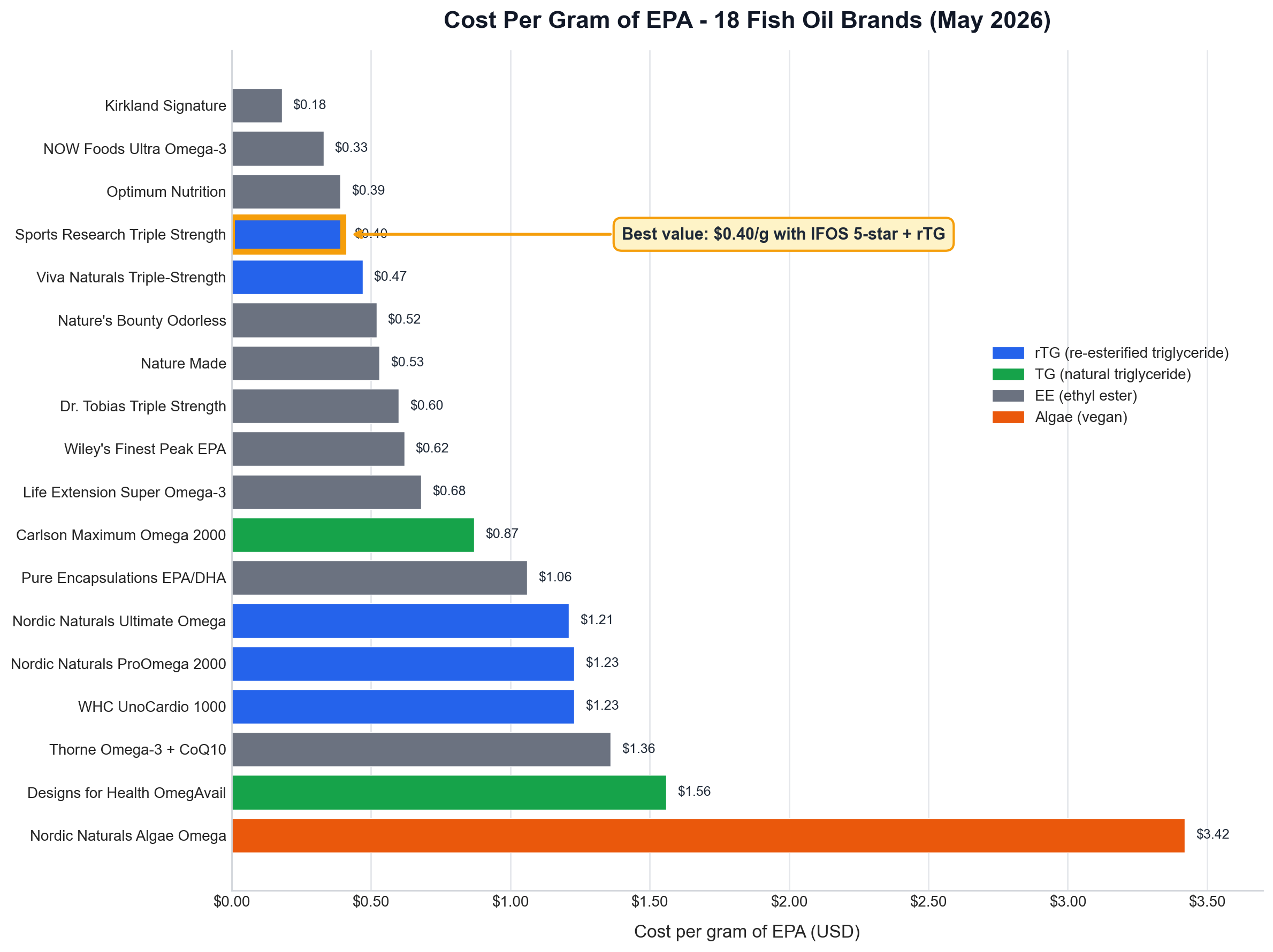
If price tracked quality, the $3.42 option would be 19x more bioavailable, 19x better tested, 19x more sustainable. None of that is true. The most expensive option in this dataset is algae-based (the vegan tax is real, and we’ll come back to it). The cheapest is Kirkland Signature at Costco — USP verified, lower EPA per cap, but functional fish oil at a price nothing else in the dataset comes close to.
What about the middle of the range?
Here’s where it gets interesting. The brands that sit between $0.40 and $1.50 per gram of EPA aren’t lined up by quality. Sports Research Triple Strength at $0.40 has IFOS 5-star certification, rTG form, and MSC sustainability credentials. Nordic Naturals Ultimate Omega at $1.21 has no IFOS certification. The cheaper one is testing more rigorously.
That’s the headline of this analysis: price and quality are not correlated in fish oil. They’re not even close. Once you strip out the algae outlier and the Costco floor, the brands occupying the $0.40 to $1.50 range are clustered by marketing budget and distribution channel, not by what’s actually in the bottle.
The implication for buyers: paying more doesn’t automatically buy you better fish oil. Paying less doesn’t automatically save you from inferior fish oil. The variables that actually matter — form (TG, rTG, or EE), third-party certification, EPA concentration per serving — show up at every price tier.
Here’s what you’re actually paying for when the price climbs.
What You’re Actually Paying For
Three things move the price needle in fish oil. Form. Certification. Distribution channel. Here’s what each one is actually buying you.
The Form Premium
Fish oil comes in three molecular forms. Ethyl ester (EE) is the cheapest to manufacture — fish oil concentrated and bound to ethanol. Natural triglyceride (TG) is the form that exists in actual fish. Re-esterified triglyceride (rTG) is concentrated fish oil that’s been converted back to triglyceride form after processing.
The research on absorption is settled: TG and rTG are absorbed roughly 50-70% better than EE. The question is whether you pay enough extra for it.
Here’s the data from this analysis:
- NOW Foods Ultra Omega-3 (EE form): $0.33 per gram of EPA
- Sports Research Triple Strength (rTG form): $0.40 per gram of EPA
That’s a 21% premium for rTG over EE at the value-to-mid-tier price point. For most buyers, that’s the right trade. You’re paying $0.07 more per gram of EPA for substantially better absorption. Over a month of supplementation, the difference might come out to a few dollars.
Where the form premium stops being worth it: when you climb past the $0.50/gram tier. WHC UnoCardio 1000 at $1.23 per gram of EPA is also rTG. The rTG form isn’t 3x better than Sports Research’s rTG. You’re paying for other things at that price point — certifications, additional ingredients (UnoCardio includes Vitamin D3), heavy metals testing below detection limits — but the form itself isn’t the differentiator.
Where the form premium is irrelevant: at the Costco floor. Kirkland Signature at $0.18 per gram of EPA is EE form. You’re getting cheaper fish oil that your body absorbs less efficiently. For someone taking fish oil daily, the absorption math can be solved by taking one more softgel per day. The Costco bottle is 400 capsules. The absorption penalty is real but recoverable through dose.
Buyer guidance: If you’re choosing between two comparably priced products and one is rTG and one is EE, take the rTG. If you’re choosing between rTG at $0.40 and rTG at $1.23, the price difference is about something else. The next subsection covers what.
The Certification Premium
Every time I’m in the supplement aisle at Costco, someone — usually a guy my age — asks me if his fish oil is “any good.” The honest answer is: I don’t know unless we look at three things, and one of them is whether anyone independent has actually tested what’s in the bottle.
That’s what third-party certification is for. Three organizations dominate fish oil testing.
IFOS (International Fish Oil Standards) is the gold standard. They test for purity (heavy metals, PCBs, dioxins), potency (does the EPA and DHA actually match the label), and freshness (oxidation, which is how fish oil goes rancid). Their 5-star rating is the highest a fish oil product can earn.
NSF and USP are general supplement certifications that confirm the product contains what the label claims and is free of common contaminants. Solid, but less specialized than IFOS for fish oil specifically.
Here’s where it gets counterintuitive: IFOS certification doesn’t cost extra.
- Sports Research Triple Strength (IFOS 5-star): $24.99, $0.40 per gram of EPA
- Nordic Naturals Ultimate Omega (no IFOS): $47.00, $1.21 per gram of EPA
Sports Research carries the most rigorous certification in the industry at about a third of the price of Nordic’s flagship product. Nordic argues their batch-specific COAs provide equivalent assurance. They might. The point is the market isn’t pricing certification — it’s pricing brand recognition. And Nordic has very good brand recognition.
This pattern repeats across the dataset. Six brands carry IFOS 5-star certification, and their prices range from $24.99 (Sports Research) to $83.26 (Nordic ProOmega 2000). Eleven brands have no IFOS certification, and their prices range from $12.99 (Kirkland) to $55.00 (Thorne). Two products with the same independent testing can be priced 3x apart. Make that make sense.
Buyer guidance: If you want third-party verified purity and potency, you don’t have to pay premium. Look for IFOS 5-star or NSF certification on the label. If a product doesn’t disclose its testing program at all, assume none is happening.
The next subsection covers the last source of fish oil price inflation: where you buy it matters more than what’s in the bottle.
The Practitioner Premium
There’s a tier of supplement brands you mostly hear about from a chiropractor, a functional medicine doctor, or a nutritionist who hands you a card. Thorne, Designs for Health, Pure Encapsulations. They’re sold through practitioner networks, often with limited retail presence, and they carry a “your doctor recommends this” halo.
The halo has a price tag.
- Thorne Omega-3 with CoQ10: $1.36 per gram of EPA
- Designs for Health OmegAvail Hi-Po: $1.56 per gram of EPA
- Pure Encapsulations EPA/DHA Essentials: $0.96 per gram of EPA
Compare those to Sports Research at $0.40 per gram of EPA, IFOS 5-star certified, in rTG form — the premium form practitioner brands position themselves as offering. Designs for Health is actually TG (also good, but not rTG). Thorne and Pure Encapsulations don’t publicly disclose form, which in this industry usually signals EE. None of the practitioner brands in that cluster offer rTG at any price. The Thorne and DFH products are 3-4x more expensive without delivering 3-4x better fish oil.
What you’re actually paying for at the practitioner tier:
- Distribution model. These brands sell through a closed network of practitioners. The doctor or nutritionist who recommends them often gets a commission or affiliate cut. The margin gets built into the retail price.
- Brand positioning. “Practitioner-grade” sounds clinical and trustworthy. The phrase has no regulatory meaning. There’s no FDA definition of practitioner-grade. It’s marketing language.
- Specific additions, sometimes. Thorne’s omega-3 includes 30mg of CoQ10 per gelcap. Designs for Health adds tocotrienols and lipase. These are real ingredients with real costs. They explain part of the premium, not all of it.
Let me be fair to these brands for a moment. Thorne has strong quality controls, fourth-party testing, NSF-certified manufacturing, and a real reputation in the practitioner space. The fish oil isn’t bad. The question is whether it’s $1.36-per-gram-of-EPA good when Sports Research is sitting at $0.40 with comparable specs.
For most buyers, no. For someone whose doctor specifically recommended Thorne and who values the closed-loop trust of a practitioner-network brand, maybe.
Buyer guidance: If your doctor recommended a specific practitioner brand and you trust the recommendation, the premium isn’t unreasonable — you’re paying for the trust relationship. If you’re buying a practitioner brand because “practitioner-grade” sounds higher quality, you’re paying for marketing. The fish oil itself, at this tier, is not 3x better than the value-tier rTG options with the same certifications.
That’s the price decomposition. Form premium, certification premium, practitioner premium. Three different things you might be paying for when fish oil climbs above $0.50 per gram of EPA. None of them is “objectively better fish oil.” It’s all about what you value: bioavailability, third-party verification, or trust in a closed distribution channel.
The next section makes this practical. Five buyer profiles, five recommendations.
Five Buyer Profiles
Profile 1: Cost-Conscious Buyer → Kirkland Signature Fish Oil
If you take fish oil every day, don’t want to spend more than $15 a month on it, and shop at Costco anyway — this is the pick. You’re not chasing optimization. You want a baseline supplement that does the job.
Kirkland Signature Fish Oil
- $12.99 for 400 softgels
- $0.18 per gram of EPA (cheapest in this analysis)
- EE form
- USP verified
- 180mg EPA + 120mg DHA per softgel (300mg total omega-3)
The catch: Kirkland is ethyl ester form, which absorbs about 50% less efficiently than the re-esterified triglyceride forms that premium brands use. That’s a real downside. The workaround is simple — take two softgels instead of one. The bottle has 400 capsules. You’ll still pay the same $0.18 per gram of EPA — the metric doesn’t change with dose, only the number of softgels you take per day.
USP verification means the bottle contains what the label claims and isn’t contaminated. It’s not IFOS, but it’s not nothing.
Where this falls short: If you’re tracking lipid biomarkers closely and want maximum bioavailability per dose, this isn’t your pick. If “absorbed less efficiently” bothers you even with the double-dose workaround, scroll down to Sports Research.
Where to buy: Kirkland Signature Fish Oil on Amazon
Profile 2: Best Overall Value → Sports Research Triple Strength
If you want the best combination of price, certification, and absorption — without paying the practitioner-brand markup — Sports Research is the smart-money pick. This is what I’d recommend to my brother. It’s what I’d buy if I weren’t already locked into Viva Naturals out of habit.
Sports Research Triple Strength Omega-3
- $24.99 for 90 softgels
- $0.40 per gram of EPA
- rTG form (re-esterified triglyceride — better absorption)
- IFOS 5-star certified
- MSC sustainability certified
- 690mg EPA per softgel
Three things are doing the work here. IFOS 5-star means independent testing for purity, potency, and freshness — the strictest standard for fish oil. The rTG form absorbs 50-70% better than ethyl ester forms like Kirkland. And the price lands at $0.40 per gram of EPA, which is half what Nordic Naturals charges for the same form without IFOS certification.
This is the brand that should be the default recommendation. The reason it isn’t more famous is mostly distribution — Sports Research sells primarily through Amazon, not through the supplement aisle at Whole Foods or the practitioner-clinic shelf. The product is the same one Nordic and Carlson are selling. The marketing budget is smaller.
Where this falls short: If you specifically need an integrated cardiovascular formula (CoQ10, vitamin K2, polyphenols), look at WHC UnoCardio below. If you want a brand your doctor specifically recommended, the practitioner brands have their place. Otherwise, this is your fish oil.
Where to buy: Sports Research Triple Strength on Amazon
Profile 3: Cardiovascular-Focused → WHC UnoCardio 1000
If you’re specifically targeting cardiovascular biomarkers — high triglycerides, elevated ApoB, family history of heart disease, or post-statin optimization — UnoCardio is the integrated formula worth paying for.
WHC UnoCardio 1000
- $54.99 for 60 softgels
- $1.23 per gram of EPA
- rTG form
- IFOS 5-star certified
- 1000mg EPA + 250mg DHA per softgel
- Adds: 25mcg Vitamin D3, 75mcg Vitamin K2 (MK-7), small dose of polyphenols
The cardiovascular thesis here is real. EPA at therapeutic doses (1-2g daily) is one of the more reliable interventions for high triglycerides — the research has been settled for decades. K2 helps direct calcium to bones instead of arteries. D3 supports the broader cardiovascular and immune picture. Bundling them in a single capsule is convenient and the dosing is sensible.
The price reflects the integration, not the fish oil. If you stripped UnoCardio down to just its EPA content, it would be priced like a $45 fish oil — defensible but not exceptional. The premium is paying for the K2 and D3 dose being measured and delivered consistently. For someone managing cardiovascular risk seriously, that consistency has real value.
Where this falls short: If you already take separate D3 and K2 supplements that you trust, UnoCardio’s premium is mostly redundant — go with Sports Research and keep your existing D3/K2 routine. If you’re not actively managing cardiovascular biomarkers, this is more product than you need.
For more options at therapeutic EPA doses, see Best High EPA/DHA Fish Oil 2026.
Where to buy: WHC UnoCardio 1000 on Amazon
Profile 4: Sustainability-Focused → Nordic Naturals ProOmega 2000
If you specifically care about sustainable sourcing and want a premium brand with a long track record on it — and the budget isn’t a hard constraint — Nordic ProOmega 2000 is the pick. (If sustainability matters but price is a constraint, scroll back to Sports Research in Profile 2 — it’s MSC certified at $0.40 per gram of EPA, which is arguably the smarter buy.)
Nordic Naturals ProOmega 2000
- $83.26 for 120 softgels (60 servings of 2 softgels each)
- $1.23 per gram of EPA
- rTG form
- IFOS 5-star certified
- Friend of the Sea sustainability certified
- 1125mg EPA + 875mg DHA per softgel — highest concentration in the dataset
The high concentration is the practical reason this product exists. Two grams of omega-3 in a single softgel means you can hit a therapeutic dose without choking down four capsules. Nordic has built its brand on this — pharmaceutical-grade fish oil with the sustainability story attached. The price reflects the manufacturing precision and the brand premium, not the fish itself.
Here’s the question that matters: does paying 3x more than Sports Research get you 3x better fish oil? No. The marginal upside is in concentration (fewer softgels per dose) and in supporting a brand that’s pushed sustainability as a brand pillar for decades. If those matter to you, the premium is defensible. If they don’t, you’re paying for marketing.
Where this falls short: If sustainability is a hard requirement but cost matters, Sports Research is the rational pick. If you don’t care about brand provenance and just want efficient EPA delivery, Sports Research is still the rational pick. Most buyers should honestly be in Profile 2.
Where to buy: Nordic Naturals ProOmega 2000 on Amazon
Profile 5: Vegan → Nordic Naturals Algae Omega
If you don’t eat fish for ethical, religious, or dietary reasons, algae-based omega-3 is your only real path to therapeutic EPA and DHA intake. The tradeoff is cost — and it’s a steep one.
Nordic Naturals Algae Omega
- $40.00 for 120 softgels (60 servings of 2 softgels each)
- $3.42 per gram of EPA — the most expensive option in this analysis
- Algae-derived (no fish, no krill)
- 195mg EPA + 390mg DHA per softgel
- Friend of the Sea certified
- Vegan Society certified
The vegan tax is 8-19x compared to fish oil. Sports Research delivers the same EPA for $0.40 per gram. Kirkland delivers it for $0.18. Nordic Algae Omega delivers it for $3.42. That math is not subtle.
Two things are doing the pricing here. First, microalgae cultivation is expensive — the algae have to be grown in controlled tanks, harvested, and processed for omega-3 extraction. Second, the market is small. Volume can’t bring costs down the way it does for sardine and anchovy oil.
Worth noting: the DHA-to-EPA ratio is inverted compared to fish oil. Algae omega-3 is naturally DHA-heavier. For most omega-3 benefits, this matters less than total dose. For specifically EPA-driven triglyceride reduction, you’ll need to take more capsules to hit therapeutic EPA levels — and the cost climbs accordingly.
Where this falls short: Nowhere, if you’re vegan. This is the category. The question isn’t whether to buy algae omega-3 — it’s whether the price is worth it to you given your dietary commitments. For most vegan buyers, the answer is yes.
Where to buy: Nordic Naturals Algae Omega on Amazon
Those are the five profiles. Most buyers fit one of them cleanly. A handful will fit two — sustainability-focused vegan buyers, cost-conscious cardiovascular buyers — and the answer there is usually the lower-cost option from whichever category matters more.
Before getting to my own pick and the bloodwork story behind it, there are a handful of questions that come up consistently when people are buying fish oil for the first time. The answers below.
Frequently Asked Questions
How much fish oil should I take?
Most adults benefit from 1-2 grams of combined EPA + DHA daily. The lower end (1g) is appropriate for general health maintenance. The higher end (2g+) is for cardiovascular optimization — high triglycerides, elevated ApoB, or post-statin support.
The research on triglyceride reduction specifically suggests 2-4g EPA per day for clinical effect. Anything above 4g daily should involve a doctor (it’s the prescription Vascepa dose for a reason). For most healthy adults not targeting a specific biomarker, 1g combined EPA + DHA is the floor that has good research behind it.
I take 1.5g EPA + 570mg DHA daily from Viva Naturals. The higher EPA ratio is deliberate — EPA drives the triglyceride reduction, which is what my bloodwork has been tracking.
For a more detailed breakdown of dose math by health goal, see How Much Omega-3 Should You Take Per Day.
When should I take fish oil — morning or night?
Timing doesn’t significantly affect fish oil’s effectiveness. Take it whenever you’ll remember to take it consistently. Consistency matters more than time of day.
The research on EPA and DHA absorption shows no meaningful difference between morning and evening dosing. Some people prefer evening dosing because fish oil can cause mild “fishy” burps if taken on an empty stomach; taking it with the largest meal of the day (often dinner) reduces this. Other people prefer morning dosing because they take all their supplements at once.
I take it with breakfast because that’s when I take my whole stack. Pick the time you won’t forget.
Should I take fish oil with food?
Yes, fish oil is better absorbed with a meal that contains fat. The fat-soluble nature of EPA and DHA means stomach acid and bile work together better on a full stomach.
Research consistently shows fish oil is better absorbed with a fat-containing meal — the practical effect is roughly a 2-3x improvement in absorption rate, with empty-stomach absorption around 20-30% and with-food absorption climbing to 60-70%. The meal doesn’t need to be high-fat — typical breakfast or lunch with eggs, dairy, or any cooking oil is enough.
The other practical benefit: taking fish oil with food substantially reduces the “fishy burp” phenomenon. If you’ve tried fish oil and quit because of the aftertaste, try it with a meal instead.
What are the side effects of fish oil?
Most common side effects are mild and digestive: fishy burps, bad breath, occasional loose stools, and mild stomach upset. These usually resolve when fish oil is taken with food or in a higher-quality form (rTG rather than EE).
At higher doses (3g+ daily combined EPA + DHA), some people experience mild blood thinning. This rarely causes problems in healthy adults but becomes relevant if you’re on blood-thinning medication, scheduled for surgery, or have a clotting disorder. The research consensus is that fish oil’s anti-clotting effect is real but mild — meaningful at high doses, negligible at standard supplementation doses.
Rare and serious side effects (allergic reactions, atrial fibrillation at very high doses above 4g/day) are documented but uncommon. If you notice anything unusual after starting fish oil, stop and talk to your doctor.
Who should NOT take fish oil?
Three groups should talk to a doctor before starting fish oil: people on blood-thinning medication (warfarin, Eliquis, Plavix, daily aspirin), people with a fish or shellfish allergy, and people scheduled for surgery within two weeks.
For the blood-thinning group, the issue isn’t that fish oil is dangerous — it’s that the combined effect with prescription anticoagulants needs medical oversight. Some doctors approve fish oil for these patients; others don’t. It depends on the specific medication and dose.
For surgery patients, most surgeons ask patients to stop fish oil 7-14 days before surgery as a precaution against bleeding risk.
Fish allergy is the obvious one — algae-based omega-3 is the workaround (see Profile 5 above).
A note on pregnancy and nursing: fish oil is generally considered safe and beneficial during pregnancy, but the DHA dose matters (typically 200-300mg daily). Always confirm with your OB/midwife.
How do I store fish oil and how do I tell if it’s gone bad?
Store fish oil in a cool, dark place — refrigeration is ideal but not strictly required for high-quality, certified products. Heat, light, and oxygen are what cause fish oil to oxidize (go rancid).
Signs your fish oil has gone bad:
- Strong, “off” fishy smell when you open the bottle (fresh fish oil should smell mild)
- Bitter or sharp taste if you bite into a softgel (fresh fish oil is mild)
- Persistent fishy burps that didn’t exist when you first started the bottle
- Softgels that look discolored or feel sticky
Rancid fish oil isn’t dangerous in small amounts, but it loses its therapeutic value and may cause GI upset. If your bottle smells or tastes off, toss it.
This is one reason IFOS certification matters — IFOS tests for oxidation specifically. Certified bottles arrive fresher and last longer.
Can I get enough omega-3 from fish instead of a supplement?
Yes, if you eat 2-3 servings of fatty fish per week — specifically salmon, mackerel, sardines, herring, or anchovies. That’s the dietary recommendation behind most omega-3 research.
The math: a 4-ounce serving of wild salmon contains roughly 1.5-2g of combined EPA + DHA. Two servings a week averages out to about 0.5g daily — equivalent to a moderate fish oil dose.
The honest caveats: fatty fish is expensive, mercury is a real concern with larger species (avoid tuna, swordfish, king mackerel), and most Americans don’t actually eat fatty fish 2-3 times a week. The supplement industry exists because the dietary recommendation is hard to hit consistently.
If you eat fatty fish regularly, you may not need to supplement. If you don’t, a 1g daily fish oil is the cheapest cardiovascular insurance in the supplement world.
That’s the practical layer. Now the personal one — my actual pick, and the bloodwork behind it.
My Pick (And Why I Haven’t Switched)
After running the numbers on 18 brands, Sports Research Triple Strength looked like the obvious recommendation. IFOS 5-star, rTG form, $0.40 per gram of EPA. Best-positioned brand in the dataset on most dimensions.
Then I did the math on my specific dose. I take 1.5g of EPA daily from Viva Naturals. I buy the 180-softgel bottle at $55.99, which lasts about three months — roughly $19 per month at my dose, or $0.41 per gram of EPA. Sports Research at the same dose would run about $18.30 per month. The difference is pennies.
(Note: Section 8’s brand table shows Viva Naturals at $0.47 per gram of EPA. That’s the standard 60-serving listing. The 180-softgel bottle I buy works out to $0.41 per gram because the larger pack is priced more efficiently — a common pattern in supplement pricing.)
Both are IFOS 5-star certified. Both are rTG form. Both land at essentially the same cost per gram of EPA when you buy efficient pack sizes. The economic case for switching doesn’t exist.
But even if it did, I wouldn’t switch right now. Here’s why.
The bloodwork is working. My triglycerides went from 239 to 74 over three years. HDL doubled from 28 to 56. And the inflammation marker — CRP, which predicts cardiovascular events — dropped from 3.0 to under 1 before I started the statin in October 2025. I can’t perfectly isolate what drove that drop. The carb reduction alone could explain much of it. But fish oil and niacin both have inflammation-reduction data behind them, and they’ve been constants in the protocol.
Fish oil specifically has been the most consistent variable. Same brand, same dose, every morning with breakfast for three years running. I can’t credit fish oil alone — the statin, the carb cuts, and 22 other daytime supplements have all been part of the picture. But I can say that whatever’s working, I’m not interested in swapping out the constants mid-protocol when the alternative offers no meaningful financial or quality advantage.
If my next bloodwork shows triglycerides creeping back up or CRP rising, I’ll revisit. Until then, Viva Naturals stays. Sports Research is the brand I’d recommend to someone starting from scratch. It’s not the brand I’m switching to yet.
Methodology and the Full Dataset
For readers who want to dig deeper, here’s the methodology behind the analysis and how to access the full dataset.
The 23 Data Points Per Brand
For each of the 18 brands, I captured:
Pricing: Container price, servings per container, monthly cost at 1g EPA daily dose, cost per gram of EPA.
EPA/DHA content: EPA per softgel, DHA per softgel, total omega-3 per serving, EPA:DHA ratio.
Form: Ethyl ester (EE), natural triglyceride (TG), or re-esterified triglyceride (rTG).
Certifications: IFOS rating (if any), NSF certification, USP verification, Friend of the Sea, MSC sustainability, Vegan Society.
Sourcing: Fish species, country of origin, sustainability practices, processing method.
Other: Capsule type (softgel, liquid, gummy), capsule size, flavoring/additives, label transparency, third-party Labdoor score where available.
The 18 Brands Analyzed
Sorted by cost per gram of EPA (lowest to highest):
| Brand | Form | Cert | $/g EPA |
|---|---|---|---|
| Kirkland Signature | EE | USP Verified | $0.18 |
| NOW Foods Ultra Omega-3 | EE | None (GOED member) | $0.33 |
| Optimum Nutrition | Likely EE | None | $0.39 |
| Sports Research Triple Strength | rTG | IFOS 5★ | $0.40 |
| Viva Naturals Triple-Strength | rTG | IFOS 5★ | $0.47 |
| Nature’s Bounty Odorless | Likely EE | None | $0.52 |
| Nature Made | EE | USP Verified | $0.53 |
| Dr. Tobias Triple Strength | EE | NSF Certified | $0.60 |
| Wiley’s Finest Peak EPA | EE | IFOS 5★ | $0.62 |
| Life Extension Super Omega-3 | Likely EE | IFOS 5★ | $0.68 |
| Carlson Maximum Omega 2000 | TG | IFOS 5★ | $0.87 |
| Pure Encapsulations EPA/DHA | Likely EE | None | $1.06 |
| Nordic Naturals Ultimate Omega | rTG/TG blend | None | $1.21 |
| WHC UnoCardio 1000 | rTG | IFOS 5★ | $1.23 |
| Nordic Naturals ProOmega 2000 | rTG/TG (90%+ TG) | IFOS tested | $1.23 |
| Thorne Omega-3 + CoQ10 | Likely EE | None (NSF facility) | $1.36 |
| Designs for Health OmegAvail | TG (Bioglycerides) | Not confirmed | $1.56 |
| Nordic Naturals Algae Omega | Algae | N/A (algae product) | $3.42 |
Prices as of May 8, 2026. Subject to change. Source data: ~/corestacks/data/omega-3-research/omega-3-data-2026-05-08.csv (all 18 brands, 23 data points per brand, data_confidence=HIGH on cost/EPA/DHA fields).
Sources
Data came from:
- Brand official websites
- Amazon and iHerb product listings
- IFOS certification database (nutrasource.ca/ifos)
- Labdoor reports (labdoor.com)
- USP-verified products database
Get the Full Dataset (CSV)
I cleaned and structured the full 23-data-point dataset into a single spreadsheet. If you want it — for your own analysis, your own comparison shopping, or because you find this kind of thing useful — Get the full 18-brand dataset (CSV) — drop your email and I’ll send the spreadsheet.
The dataset includes everything: raw pricing, EPA/DHA breakdowns, certifications, sourcing details, and the cost-per-gram-EPA calculations for each brand.
A Note on What’s Not Included
This analysis covers fish oil and algae-based omega-3 supplements available through major U.S. retailers as of May 2026. It does not cover:
- Prescription omega-3 medications (Vascepa, Lovaza) — these are pharmaceutical-grade and require a doctor’s prescription. They serve a different clinical role than over-the-counter fish oil.
- Krill oil and seal oil — different omega-3 sources with different EPA:DHA profiles and price structures. Worth their own analysis. For the comparison, see Fish Oil vs Krill Oil: Which Omega-3 Source Is Better?.
- Cod liver oil — historically common, currently a smaller market segment, often dosed differently due to vitamin A and D content.
- Custom-compounded supplements from functional medicine practitioners.
For most buyers shopping over-the-counter fish oil in 2026, the 18 brands above represent the meaningful market.
That’s the analysis. The right pick is whichever one you’ll actually take every day.
Free: My Complete 34-Supplement Protocol
Every brand, dose, cost, and why — from 7+ years of research and 5 blood tests.
Get the Free PDF →Top-Rated Omega-3 Supplements
Affiliate links help support CoreStacks at no extra cost to you.
Found this useful? Share CoreStacks with a friend →